

Reclaiming The Commons
Why environmental mobilization in Albania has proven an effective entry point for commons claims

On May 23, 2026, residents of Zvërnec, a small coastal village in southwestern Albania, blocked access to a construction zone near the Narta Lagoon, home to flamingos and more than two hundred migratory bird species. The site borders Sazan Island, Albania’s only marine and terrestrial national park. What they were blocking was not an act of illegal seizure. The resort project underway there, linked to Jared Kushner and his company, had been made formally legal two years earlier, when Prime Minister Edi Rama’s parliamentary majority amended Albania’s Protected Areas legislation to permit five-star resorts inside protected landscapes, regardless of what the founding decrees of those landscapes allowed. The government did not steal the flamingo habitat. It transferred it legally.
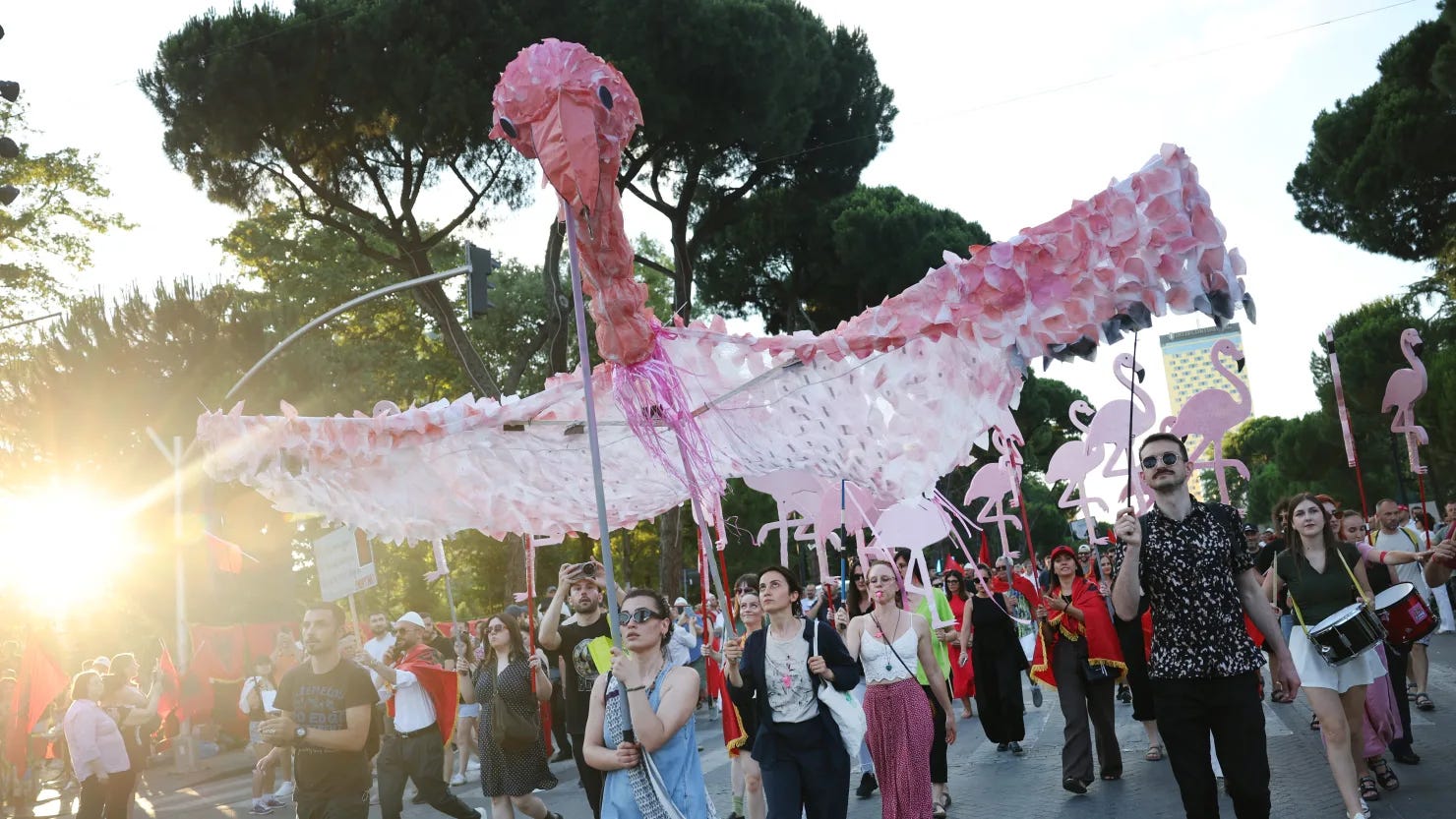
Within weeks, thousands were rallying in Tirana. By June 20, tens of thousands filled the capital in what observers described as the largest anti-government demonstration in years — the most serious challenge to Rama’s fourteen-year rule. The movement’s slogan, “Albania is not for sale,” has been read as nationalist sentiment. It is better read as a property claim.
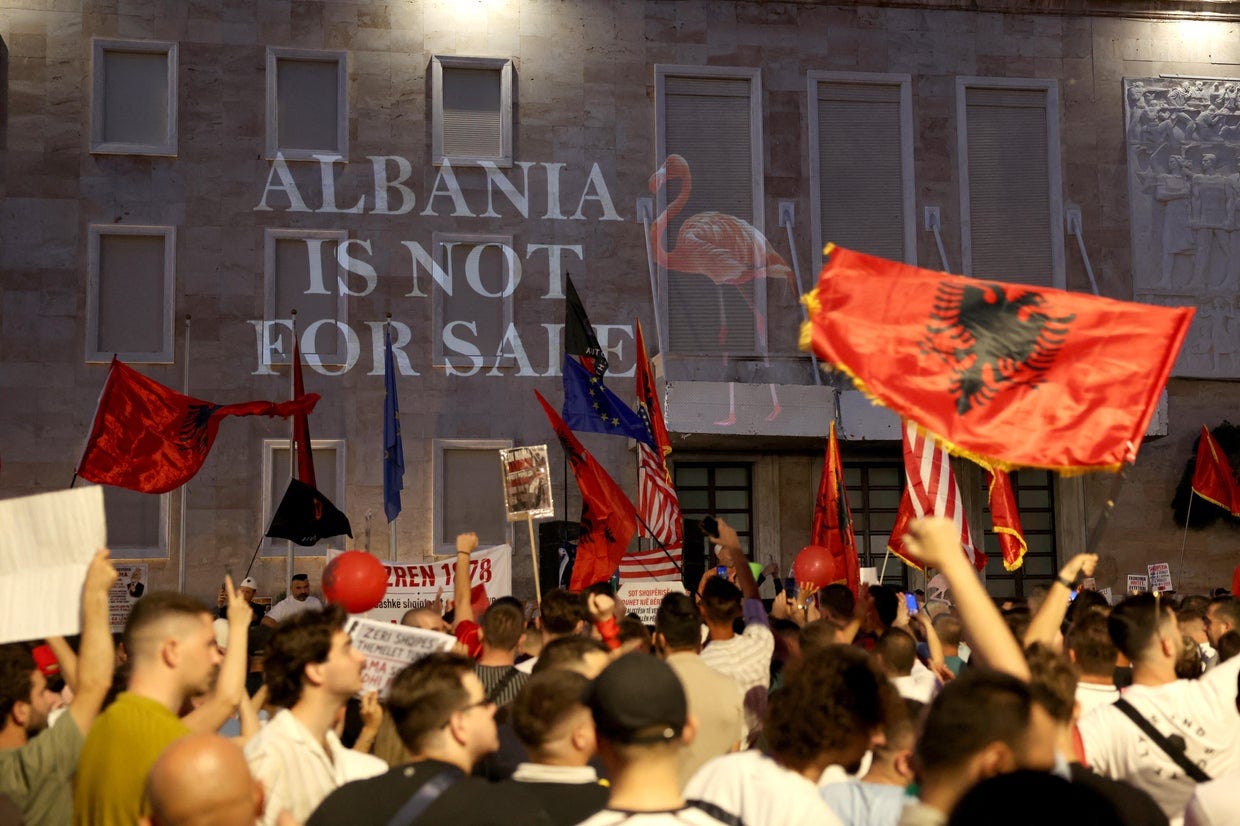
Image source: CBS News
The Albanian protest is the most vivid instance of a pattern visible across Central and Eastern Europe and the Western Balkans in 2025–26. In Georgia, Serbia, and Slovakia, civic mobilizations of considerable scale have challenged governments whose common feature is not ideological alignment but a specific practice: the legal alienation of collective assets — land, institutional integrity, energy infrastructure, public procurement — to external interests whose access to those assets depended on the government’s willingness to rewrite the rules. These are contests over the commons, and understanding them as such matters because it changes what we think the movements are demanding and what conditions their success.
The concept of the commons, in the post-socialist context, requires some specification. The 1989 settlement included an implicit promise about collective assets: privatization would distribute former state property, but certain goods, such as protected environments, functioning public institutions, and infrastructure built with public capital, would be governed under rule-of-law frameworks that made them accountable to the populations who depended on them. That promise has been systematically eroded, not primarily through theft but through legal instruments purpose-built to accomplish the same result: strategic investor designations that exempt foreign capital from ordinary planning and environmental review, protected-area amendments that pre-empt conservation law, procurement frameworks that channel public contracts to connected firms. The legal form is what makes these transfers particularly difficult to contest through ordinary political channels. The government has not done anything illegal. It has simply changed what is legal.
Albania’s case is the paradigm. The 2024 protected areas amendment did not emerge from a general review of conservation policy. Albania’s Special Structure Against Corruption and Organized Crime (SPAK) is now investigating how key parcels around the Narta Lagoon changed hands and how the legislative amendment was structured — an investigation whose existence signals that Albania’s anti-corruption institutions have reached a threshold of independence sufficient to scrutinize the transaction, if not yet sufficient to have prevented it. Meanwhile, the European Commission has warned Tirana to “act without delay”, not because the project violates Albanian law — it was carefully structured not to — but because it violates the environmental acquis that Albania has formally committed to as an EU accession candidate. The contradiction the protest movement has correctly identified is that Rama simultaneously invokes EU accession as the legitimating purpose of his government and pursues transactions that Brussels considers incompatible with that candidacy.

Across the region, the class of commons being contested varies, but the structural logic is consistent. In Serbia, the November 2024 collapse of the newly renovated Novi Sad railway station canopy, which killed fifteen people, triggered the largest civic mobilizations Serbia had seen in years, including a nationwide student strike. The station had been rebuilt using public capital, under a procurement process that Serbian civil society and opposition figures had long identified as a vehicle for clientelist extraction. The infrastructure that should have been a commons maintained through accountable public procurement had instead been subjected to the private logic of connected contracting. Students occupied universities — themselves institutions of the public commons — to make the point visible. In Georgia, the Foreign Agents Law passed by the Georgian Dream government in 2024 attacks civil society organizations as institutional public goods: the argument advanced by the law’s supporters, that foreign-funded NGOs represent external interference, is precisely inverted by the protesters who understand those organizations as part of the commons of democratic infrastructure that the state is obligated to protect rather than dissolve. In Slovakia, Prime Minister Fico’s pursuit of bilateral Russian gas arrangements and his public endorsement of Druzhba pipeline restoration positions national energy infrastructure as something the government can manage on its own terms rather than within the collective European framework — a contest over who controls the terms of access to an asset built with public capital and maintained, until recently, as part of a collective European energy commons.
What unites these movements, despite their different national contexts, is the specific register of their demands. They are not primarily asking for elections, party alternation, or abstract democratic improvement. They are asserting that particular assets and public spaces have collective owners whose consent was not sought and cannot be manufactured through legislative amendment. “Albania is not for sale” is not a slogan about sovereignty in the sense in which Viktor Orbán uses that word — as a shield against EU standards and a cover for domestic elite capture. It is a claim about the inalienability of specific commons, grounded in the legal commitments Albania has made and the material interests of the communities most directly affected.

This distinction matters for understanding why environmental mobilization has proven so effective as the entry point for commons claims. Environmental assets are locally specific and visually concrete in a way that institutional integrity is not. A flamingo colony communicates in a political register that “rule of law” cannot access. But environmental mobilization also works because it internationalizes the commons claim: EU environmental standards create external obligations that governments cannot simply legislate away, which is precisely why Brussels has had to respond to Zvërnec when it might otherwise have remained silent. The environmental acquis is not merely a policy commitment — it is a mechanism through which communities can invoke obligations their governments have already made, in forums their governments cannot entirely control.
This is what the EU’s role in these movements actually amounts to, and it is more specific than the familiar narrative of “democratization through integration.” The movements are not asking Brussels to impose liberal democracy on reluctant governments. They are asking it to enforce standards — environmental, procurement, anti-corruption — that accession candidates and member states have formally accepted. The EU is not being asked to do something novel. It is being asked to do what it already committed to do. That the ask feels ambitious in 2026 reflects the extent to which Brussels has allowed conditionality to function as a bargaining instrument rather than a binding standard: the partial release of Hungary’s frozen funds before genuine rule-of-law compliance, the scramble to accommodate Romania’s governance failures before the August 31 RRF absorption deadline, the continued progress of Albanian accession negotiations alongside a protected-areas amendment that the Commission itself has flagged as incompatible with the acquis.

The movements will achieve bounded successes. The Kushner resort may be stopped as SPAK’s investigation, the international attention, and the EU’s formal warning have raised the political cost of proceeding beyond what the transaction was designed to bear. The Novi Sad prosecutions may produce convictions. Georgian civil society organizations, for all the pressure they face, remain operative. These are not revolutionary outcomes, but they are not nothing. The commons, once defended in a specific case, creates a precedent and an organizational infrastructure that the next movement can use.
The deeper question is whether commons claims can be institutionalized — converted from mobilization into legal architecture and a hardened political norm that a parliamentary majority won’t manage to change in a single session. Albania’s EU accession process is, in principle, the vehicle for exactly that: an environmental acquis, procurement standards, and anti-corruption institutions locked in as conditions of membership rather than subject to revision by whoever holds power in Tirana. Whether Brussels will treat those conditions as genuinely binding, or continue to negotiate them against the political calendar of enlargement, will determine whether the flamingo at Zvërnec is remembered as the symbol of a movement that forced a structural change or the emblem of a protest that stopped one resort and left the underlying architecture intact.